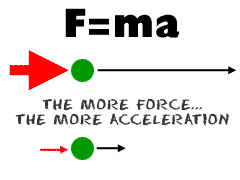
 Remember that Newton's first law stated that an object with no net force acting on it will not accelerate. Newton's second law of motion, though, states that an unbalanced force (one that is not equally opposed by another force) acting on an object will cause the object to accelerate. The object's mass, which measures its inertia, also determines how much the object's movement will change. From this, Newton derived the formula a= F/m, where acceleration is directly proportional to force and inversely proportional to object mass.
Showing posts with label Mass. Show all posts
Showing posts with label Mass. Show all posts
Sunday, October 28, 2012
Law of Acceleration
Remember that Newton's first law stated that an object with no net force acting on it will not accelerate. Newton's second law of motion, though, states that an unbalanced force (one that is not equally opposed by another force) acting on an object will cause the object to accelerate. The object's mass, which measures its inertia, also determines how much the object's movement will change. From this, Newton derived the formula a= F/m, where acceleration is directly proportional to force and inversely proportional to object mass. 
The Law of Inertia
Newton's first law states that an object has a certain inertia, which allows it to resist a change in its state. Mass is the measure of this inertia, and is measured in kilograms (if using SI units). As a result of this inertia, an object that is at rest will remain at rest, and one with a constant velocity will continue moving with that velocity, unless acted upon by another object.
 |
| Unless something moves this turtle, it will remain still until it chooses to move. |
Tuesday, October 2, 2012
"What goes up, must come down."
 |
| Gravity causes my dog to land on the ground seconds after he jumps, rather than continuing to gain height. |
Subscribe to:
Posts (Atom)