 Torque is what allows a figure skater to skate on ice. A skater pushes one of his/her feet against the ice in order to exert a torque on his/her body and thereby initiates a spin.
Showing posts with label Force. Show all posts
Showing posts with label Force. Show all posts
Monday, January 21, 2013
Skating on Ice
Torque is what allows a figure skater to skate on ice. A skater pushes one of his/her feet against the ice in order to exert a torque on his/her body and thereby initiates a spin.
Thursday, January 17, 2013
Designing a Door

Tuesday, January 15, 2013
Torque, Clarified
 It is important to note that torque is not always determined by the total force applied on an object. Instead, it is only the force that is perpendicular to the lever arm that is taken into account in the calculation.
Saturday, January 12, 2013
Torque (cont)

T = Fd, which means that the torque equals the distance from the axis of rotation to the place where the force is applied (d) multiplied by the magnitude of the force (F). Maximizing the torque of a force has many real-world benefits, so being able to calculate it is beneficial.
Thursday, November 29, 2012
Earth's Gravitational Pull

In addition to cannonizing his three laws of motion, Newton also created the Law of Universal Gravitation, which makes it possible to determine the force of gravity between two bodies, such as the Earth and the moon.

Wednesday, November 7, 2012
Tension
Tension is a type of contact force which exists in a string, rope, wire, or cable when it is being pulled, specifically on both of its ends. In opposition to being pulled, the string applies an equal tension force on the objects, pulling them towards itself.
Tension is a vector, and therefore has a direction and a magnitude.
The force itself is called a tension force because the rope is in a state of tension. 

Thursday, November 1, 2012
Mousetrap Car
 It is possible to create a car out of a common household mousetrap. How you ask? By attaching wheels to the moustrap, the turn of the back axel, which initiates the motion of the car, can be caused by the snap of trap.
Sunday, October 28, 2012
Law of Acceleration
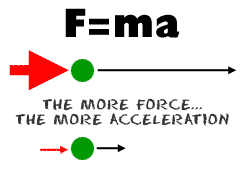 Remember that Newton's first law stated that an object with no net force acting on it will not accelerate. Newton's second law of motion, though, states that an unbalanced force (one that is not equally opposed by another force) acting on an object will cause the object to accelerate. The object's mass, which measures its inertia, also determines how much the object's movement will change. From this, Newton derived the formula a= F/m, where acceleration is directly proportional to force and inversely proportional to object mass.
 Tuesday, October 2, 2012
"What goes up, must come down."
 |
| Gravity causes my dog to land on the ground seconds after he jumps, rather than continuing to gain height. |
Subscribe to:
Posts (Atom)